Blog
Agentic AI Governance: What CISOs Must Control Now
Agentic AI is acting autonomously. Learn how CISOs must evolve governance from oversight to real-time control before AI systems outpace security.
Jason Koestenblatt
Senior Manager, Content Marketing
June 9, 2026

Traditional models built on committees and periodic reviews can’t keep pace with autonomous systems. To stay ahead, organizations must view governance as the foundation of their establish continuous observability. The priority is to dual path: approve AI use cases and architect control over what AI systems can access, decide, and execute.
Key Takeaways
- Agentic AI shifts risk from outputs to actions and system behavior
- Governance by committee cannot scale to autonomous AI environments
- Real-time, embedded policies and procedures are now required for control
- Observability and runtime enforcement are critical security capabilities
- CISOs must design AI governance as infrastructure, not oversight
The Shift: From Isolated Models to Autonomous Systems
In its early stages, AI governance focused on models. Teams validated training data, tested outputs, and monitored performance. This approach worked when AI systems were comprised of traditional machine learning models that were narrow and predictable.
Modern AI systems are embedded into workflows across the enterprise. They generate content, automate decisions, and increasingly act on behalf of users. Agentic AI extends this further. These systems initiate actions, coordinate across tools, and adapt in real time.
This introduces a new category of risk. It’s not enough to validate outputs in periodic reviews. Organizations must now govern behavior during the session.
AI is now embedded across the enterprise and operating at scale, making governance a necessity rather than an afterthought.
Why Governance by Committee Breaks Down
Most organizations start with governance by committee. This creates alignment and defines accountability across security, legal, and data teams. But it doesn’t scale.
Three pressures emerge as AI adoption accelerates:
- Speed increases as teams deploy AI independently
- Scale expands as dozens of use cases become hundreds (sometimes thousands)
- Autonomy grows as systems begin to act without human intervention
At this point, governance is a bottleneck, not an enabler. Manual processes introduce delays and documentation fragments across systems. Teams either wait for approval or bypass governance entirely. Both outcomes increase risk.
This isn’t a failure of governance strategy — it’s a failure of execution.
The New Risk Surface: Policing Actions, Not Outputs
Agentic AI changes the target of policies and procedures. Traditional policies ask whether outputs are accurate or compliant; policies for agentic AI must focus on what systems can do.
This includes:
- What actions an agent can initiate
- What data it can access
- What systems it can influence
- How decisions propagate across workflows
An agent that triggers a payment or exposes sensitive data introduces immediate operational risk. There is no reaction time between output and negative impact.
This is why governance must evolve. It must leverage policies to monitor decisions, enforce controls during execution, and stand-up guardrails to guide interactions between systems.
Step-by-Step: How CISOs Should Adapt Governance
Step 1: Establish Policies and Procedures Built for Runtime
Policies must be enforced during execution, not just before deployment. This means embedding controls that limit what agents can do in real time and what level of human accountability is required.
Step 2: Establish Full Observability
Every action must be logged and traceable. Observability enables incident response, compliance validation, and system accountability.
Step 3: Control System Interactions
Agentic systems rarely operate alone. Governance must extend to how systems interact across APIs, workflows, and other agents.
Step 4: Automate Policy Enforcement
Manual governance cannot scale. Controls must be programmatic and continuously enforced across environments.
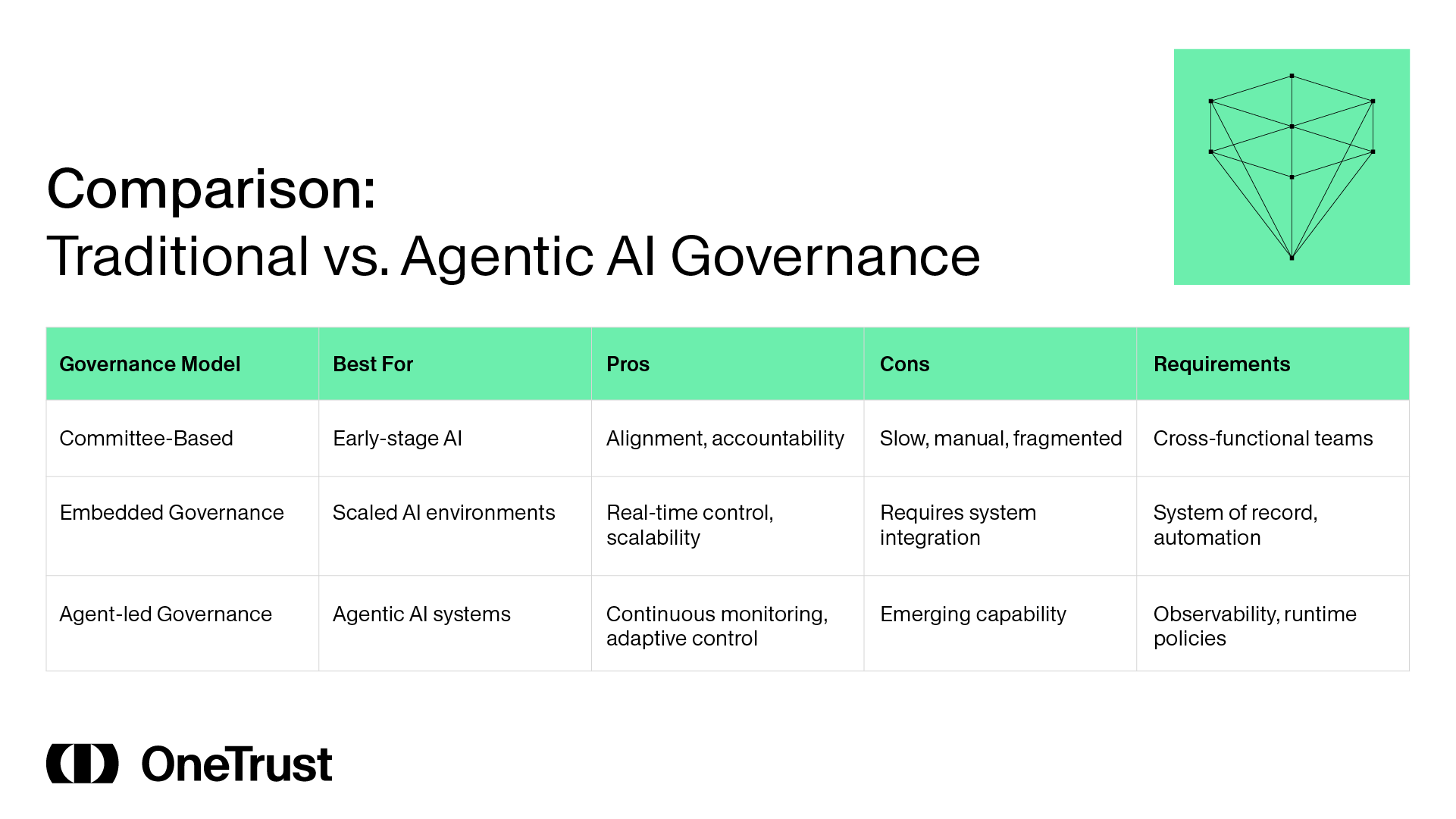
Governance as Infrastructure
The inflection point for enterprises is clear: governance must move from process to system.
Organizations reach a stage where oversight through meetings alone no longer works. Governance must be operationalized through a system that connects AI use cases, data, models, and risk signals.
When governance is embedded into workflows, it becomes part of how work gets done. It is no longer an external control layer and becomes infrastructure.
This shift unlocks several advantages:
- Approval timelines shrink because requirements are standardized
- Visibility improves because systems are tracked centrally
- Risk is identified earlier because monitoring is continuous.
- Success rates improve as risks are proactively identified and mitigated
Governance now enables innovation rather than just being another reactive security layer in your tech stack.
Agents Governing Agents: The Next Evolution
A key development in this space is the emergence of layered governance models.
In these systems, multiple agents perform distinct roles. One executes tasks. Another monitors compliance with policies. A third evaluates behavior over time and escalates anomalies.
This model aligns governance with the speed of AI.
Instead of relying on human review cycles, governance operates continuously. It adapts to system behavior in real time.
This approach reflects a broader industry shift toward autonomous governance systems, where control mechanisms operate at the same pace as the AI they manage.
What CISOs Must Govern Before It Governs Them
The priority is not to manually review every AI system. It is to define the control plane that governs them automatically.
CISOs should focus on four control areas:
- Data access and exposure
- Permissible actions and system behavior
- Observability and auditability
- System-to-system interactions
These controls must be enforced continuously, not periodically.
Want to operationalize AI governance in your security operations in real time?
Explore how to embed continuous governance into your AI programs with this on-demand webinar.
FAQs
Agentic AI refers to AI systems that can take actions independently, such as triggering workflows, making decisions, or interacting with other systems without constant human input.
Because these systems act autonomously, they can introduce immediate risk through incorrect decisions, data exposure, or unintended system interactions.
Traditional governance focuses on model outputs and validation. Agentic governance focuses on actions, runtime behavior, and system interactions.
Governance by design means embedding policies, controls, and monitoring directly into AI systems so they operate continuously and automatically.
The CISO is responsible for defining and enforcing security controls across AI systems, ensuring data protection, observability, and risk mitigation at scale.